


Before the millions of pounds and hundreds of charges, there were a handful of troubled kids and a church.
This weekend, I managed to secure Oasis tickets for Knebworth; pair that with our new prime minister and the current situation surrounding Manchester City being found guilty of 115 charges relating to financial misconduct over the last decade or more, and it’s fair to say Manchester is having a moment.
Now, I am not a City fan, and this is by no means a piece that is trying to divert from the current noise surrounding the club, but it did make me want to dig a little deeper into the past and go back to their roots. Back before the sheikhs, the sponsors, and even before the Gallagher brothers were a twinkle in their father’s eye. In these times of corruption, billionaires and corporate greed, it is often a nice reminder to look back on what it is about football, and specifically its role in the community, that made us fall in love with the game in the first place. It led me to the fascinating story about how Manchester City were originally founded in West Gorton at St Mark’s Church, in 1880, as a way to curb gang violence.
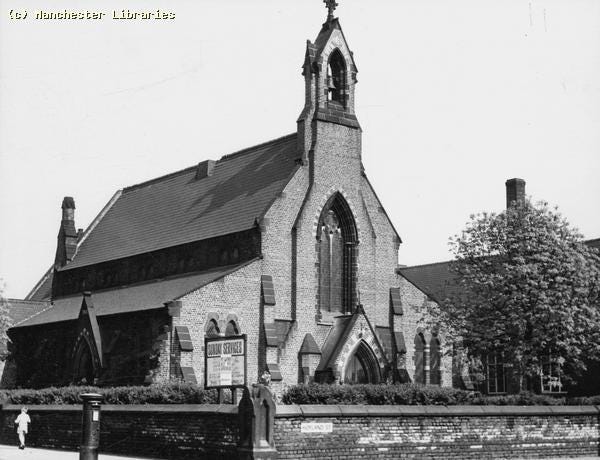
West Gorton is a suburb of East Manchester and at the time would have been a built-up residential area, among railway sidings and engineering works. There was high unemployment, and the area was plagued with street gangs made up of mostly young men. These street gangs would often partake in the violent act of “scuttling”. This is where large groups would meet up in organised fights, often with extreme violence, to settle personal grudges or for bragging rights over land and territory. Weapons of choice in these organised fights—sometimes containing hundreds of young men—would be stones, knives and ornate belt buckles.
With little opportunity, no direction and too much time on their hands, these susceptible young men would find a sense of belonging in the marauding gangs that were becoming a scourge on the area—sound familiar? I can only imagine how much worse it might have been if they had Lime bikes.
The story goes that the rector’s daughter of St Mark’s, Anna Connell, got wind of what was going on and wanted a way to keep the men entertained, focusing their energies elsewhere and also keeping them away from the pub—I have been in a few football teams in my adult life, and I would say as good as they are for all of the above, staying out of the pub is not one of them. The church already had a Cricket team, founded in 1867, and many of them also moved across to the football team, but it was, by all accounts, fundamentally set up as a way to curb the gang violence in the area and as an outlet for the troubled, rudderless young boys.

What makes this story all the more potent is that Manchester City could technically be the only men’s club in history to be founded by a woman.
Although two churchwardens, William Beastow and Thomas Goodbehere, are largely credited with the foundation of St Mark's (West Gorton) football team in its official capacity, it wouldn’t be the first time in history that a woman’s role has been overlooked. However the history books choose to remember it: Anna Connell was vital in bridging the gap between the troubled youths and giving them a direction through sport.
The two churchwardens also worked at the Union Iron Works nearby, which became the ‘home ground’ for St Marks. A far cry from the Etihad of today, where hospitality would have meant a cup of tea and, if you were lucky, a dash of milk.
The first ever game was recorded on the 13th November 1880, against another church in Macclesfield, in which St Mark’s lost 2-1. They would have to wait until the following year to record their first victory against Stalybridge Clarence in March 1881. They spent four years playing as St Mark’s until they lost their ground and were forced into a short-lived merger with Belle Vue Football Club, lasting only a year.
After three more years as Gorton Association Football Club, they were forced to move on again and settled in Ardwick, next to a railway viaduct. The final year of Ardwick Association Football Club was in 1894—the eagle-eyed City fans know this as the official year that their beloved club was founded—and this was particularly significant because that was the year that the Manchester Ship Canal was opened. The 36-mile ship canal allowed merchant ships in the Irish Sea access to the landlocked industrial town, transforming Manchester into a major port. Hence why the three-masted ship takes centre stage in the current Manchester City badge.

Interestingly, the red rose of Lancashire also represents a time when Manchester was in the county of Lancashire before it was restructured into Greater Manchester in 1974.
In their over 120 years as MCFC, it has not been all plain sailing for the blue side of Manchester, and any City fan worth their salt will tell you about the rollercoaster days culminating in a stint in Division 2—the only time they have dropped into the third tier of English Football. But before we get the world’s smallest violin out, we are much more aware of the Manchester City of recent years, with an embarrassment of riches, world-class players and a trophy cabinet any club would envy. Add to all of that the very unwanted 115 charges and they have come a long way from a social project in West Gorton.
Now they are arguably about to face one of their toughest periods in the club’s history. As we all get the popcorn out, jeer from the stands and bay for blood, spare a quick thought for West Gorton, the scuttlers and a woman who knew how important direction, purpose and hope could be in transforming the lives of young people. How, away from the glitz and glamour, football can be a way to heal, to provide, and to better the wider community.
Unfortunately, with vast sums of money, corruption is never far away. I wonder whether the billions that are invested by individuals, families and investment funds linked to god knows what are aware of the humble beginnings of some of these clubs that they invest in? Do they really understand what the badge represents, what a club can mean to a city, a community, or an individual?
So City fans, Don’t Look back in Anger, think back to the times when your players were full of Cigarettes and Alcohol. Because at the end of the day, owners will come and go, but the origins of a club will—Live Forever.
Thanks for reading.
And remember: It’s never just a Game.