


With the new football season kicking off, I thought this little nugget might interest you.

USSR vs MEXICO: May 31st, 1970
Who remembers this one then? (insert crickets). Well, if you do, it shouldn’t be because it was the opening match of the Mexico World Cup—the first to be held outside of Europe, for whoever’s asking—nor should it be for the 0-0 scoreline, which must have been thrilling for the more than 107,000 in attendance at the Azteca stadium. It was, you guessed it, the first time a referee brandished a yellow card.
I don’t know about you, but I thought the invention of red and yellow cards would’ve come a bit earlier than 1970. By that time we had already invented the microwave, sent a man to the moon, and given peace a chance.
The system used to caution players before was: The referee would have a word in the player’s ear, warning him that “next time you’d be off”, write it down in a little notebook (hence the term ‘booked’), and perhaps use gestures to convey this to the crowd and managers. I can think of a few gestures flying around a football stadium that could definitely let a referee communicate what he thinks of a player. I mean, the jury is still out on VAR, but that previous system was certainly open to interpretation. Now, I can already hear some people—“those were the days when a man wouldn’t need to be told; if he knew he was in the wrong, he’d just walk”—but those were also the days of Tuberculosis and the Church taking babies away from young single mothers, so thankfully, times change. Times certainly did change for the refereeing system. It wasn’t necessarily the blaggers trying to get one over on the officials that called for a rethink on how to control the players, but rather the language barrier when it came to international games.
Now entering the field of play: English referee Ken Aston. He is widely credited with introducing the colour-coded system as we know it today. A man also noted for officiating an infamous World Cup game deemed “uncontrollable” between Chile and Italy in 1962. A match dubbed “The Battle of Santiago”. Many cite that this might have been one of the factors in calling for an internationally recognised system (Perhaps more on that match in the future).
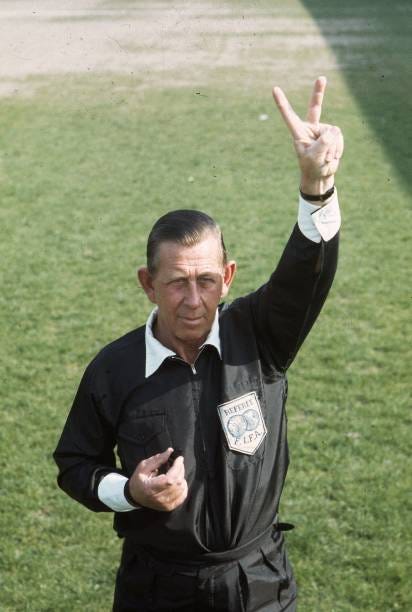
It only took 8 more years from that infamous match—and an English World Cup in between, yay!—before Ken’s system was implemented. Which brings us back to that fateful day at the Azteca in 1970.
Slow down…
The first player to be brandished a yellow card in the history of the beloved game was, of course… Georgian Midfielder (USSR) Kakhi Asatiani. By all accounts, not necessarily a Mark ‘Chopper’ Reid in the middle of the park, having been voted ‘the most graceful player’ of the championship. Although I have to say the challenge was far from graceful, I believe it would definitely get a look from VAR for a potential upgrade in today’s game (sigh).
I’m aware that the actual historical brandishing of the card wasn’t captured in the footage (you all complain about the cost of your sport subscription packages). Allow me to set the scene— what the official holds up is a small, rectangular, yellow piece of card…a yellow card, if you will.
The referee who issued it was German, Kurt Tschenscher, in the 30th minute. Imagine how much time he saved brandishing this novel technology instead of explaining in a broken mix of German, Russian and gesticulation. In fact, he seemed to save so much time that he tried it out again with another booking a minute later in the 31st and another three minutes later in the 34th. I mean that’s German efficiency for you. It almost reminds me of getting my first shiny Panini sticker as a kid. I couldn’t stop showing it off until I was asked politely by a teacher to put it away. I’m sure it was a Panini sticker I’m thinking of, anyway I digress…
STOP!
Right let’s get down and dirty, we all know what’s coming next. Who was the first ever player to get a red card? I can already hear pub quiz masters cautioning me, telling me to ‘calm down’, perhaps they are even brandishing an imaginary yellow card of their own. However, like Premier League yellow card record holder Gareth Barry before me—yeah, I was surprised at that one too—I just won’t listen.
Despite Kurt Tschenscher’s best efforts of trying to write himself into the annuls of sports history, we had to wait until the following World Cup in ‘74 to see red for the first time. The eagle eyed among you will notice that the system was clearly not adopted domestically in the interim, unless of course it was the cleanest and most fairly played four years of football ever seen? (Spoiler: it wasn’t).
Chilean forward Carlos Caszely was the first player to receive a red card playing against the hosts West Germany on the 14th June 1974. Doğan Babacan, the Turkish referee brandished it for what he deemed a second bookable offence.
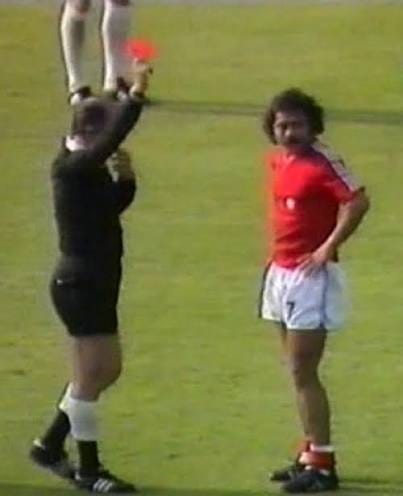
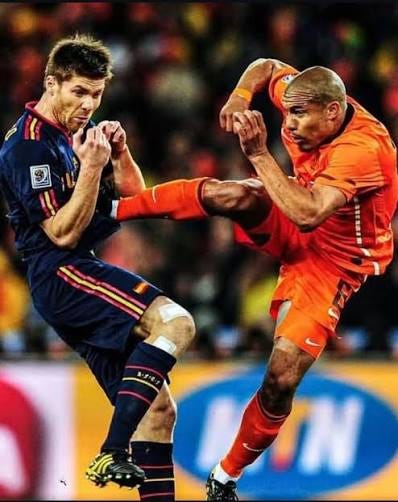
But the first player to get a straight red card? Well that happened only a day later in the match between Uruguay and Netherlands. The Uruguayan defender Julio Montero Castillo was sent off for ‘a major foul’ it was the ex Liverpool, defender’s—that’s Liverpool Montevideo by the way—third foul of the match. Although little is documented about the nature of the infringement, I would still very much doubt that it was as bad as Nigel De Jong’s mortal kombat finisher on Xabi Alonso in the 2010 World Cup final, which only resulted in a yellow card!
There you are then, a colour coded system still very much unchanged today—although I have read somewhere of a white card being brandished in Portugal for good sportsmanship, arguably the worst thing to be created there since Ronaldo’s statue—and all thanks to a bit of good old London traffic. So, the next time you are stuck cursing a red light, or shouting at it to change, direct your frustration at Ken Aston and the way he gave us all a simple and universal system to feel hard done by.
How could this be a movie? I’m not sure this one could be. There is another refereeing story that I will be tackling in a future edition of ‘How could this be a movie’, but for now this particular story gets a red card for any further development.
Be sure to subscribe to get next week’s story straight to your inbox, and remember, it’s never just a game.
Thanks for reading.
If you enjoyed this please share with those you feel may also need this in their life! Thanks for reading.